

Bearings, fasteners, retaining rings, forgings, wheel discs, and other components. These are subjected to regular in-service inspections. These also benefit greatly from testing. Thus, provides high-sensitivity evaluation with very high consistency.
How does it work?
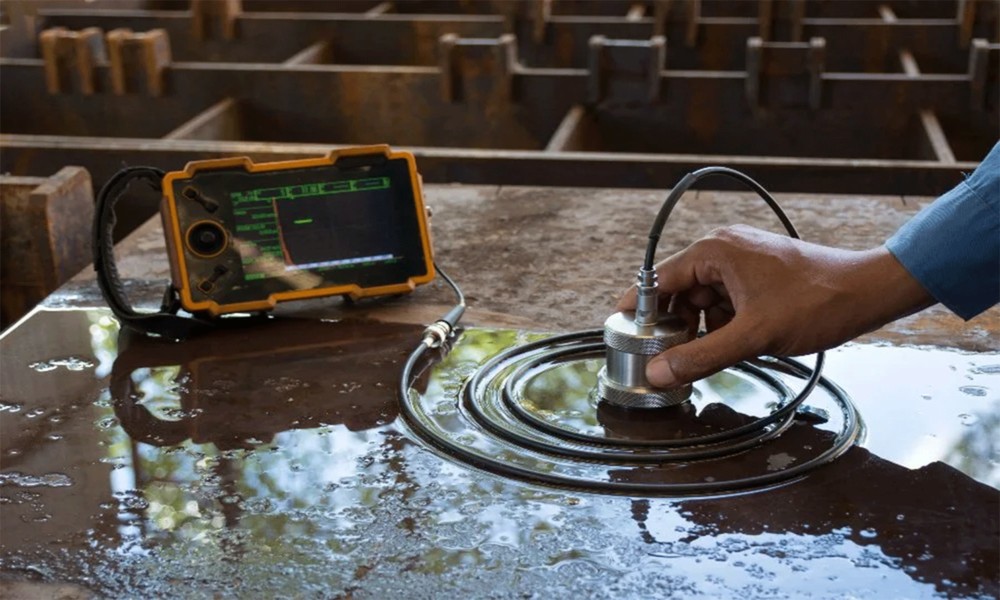
In UT, a piezoelectric transducer is coupled with a flaw detector. This is essentially an oscilloscope display and pulser-receiver.
The object being examined, which is usually connected to the test material via gel, oil, or water, travels over the transducer. When conducting tests using non-contact methods. Such as electromagnetic acoustic transducers, or EMAT, and laser excitation.
This coolant is not necessary. But it is essential to effectively transfer audio energy into the part coming from the transducer.
Principle
UT uses high-frequency sound energy to perform measurements and inspections. For instance, dimension measurements, material characterization, fault evaluation and identification, etc. These can all be done with UT.
The general Ultrasonic Inspection concept will be illustrated using a common pulse/echo inspection configuration. A transducer, pulser/receiver, and display are among the functional parts of a conventional UT system.
A pulser or receiver is an electronic device that produces high-voltage electrical pulses. The pulser controls the transducer, which generates high-frequency ultrasonic energy.
After being introduced, sound energy waves pass through the materials. When the wave path is interrupted (e.g., by a crack). Some of the energy bounces back from the defect surface. The signal from the reflected wave is transformed into a voltage signal by the transducer and shown on a screen.
The power of the signal that was reflected and the time it took to get an echo. That’s after the electrical signal is created are depicted in the above image. There is a clear correlation between the signal transit time and the signal distance. Sometimes the signal can be used to determine the reflector’s position, direction, size, and other features.
Techniques
- Pulse Echo/Straight Beam Testing
In compression wave pulse-echo techniques. Vibrational energy is typically directed perpendicular to the imaging surface using single or dual crystal transducers. These techniques are commonly known as straight beam testing.
- Angle beam
High-frequency sound waves are directed into a test sample at a precise angle to its testing surface via the angle beam technique. The test specimen may produce transverse, surface, or mixed longitudinal as well as transverse wave modes. Transverse wave sensors are commonly used to test angle beams.
Transverse waves at various refracted angles from 35° to 80° are utilized. This is to find defects whose orientation is inappropriate for detection by traditional beam techniques.
Go to https://www.nde-ed.org/NDETechniques/Ultrasonics/ultrasound.xhtml for more info.
Applications

Ultrasonic examination of:
- Bearings
Ultrasonic detection of the absence of a link between the journal and thrust bearings’ babbitt metal. As well as the foundation material that supports it.
The test for Babbitt metal’s lack of bond is based on detecting the absence of sound transfer. Especially at the base-babbitt metal interface, where the bond is absent.
Furthermore, depending on the area’s size, the typical reflection configuration from a coupled babbitt. It is either completely absent or has a reduced amplitude. The RF phase inversion approach is another method for identifying a lack of binding.
- Fasteners
Evaluating fasteners, bolts, and studs using ultrasonic technology. Finding service-induced breaks that compromise the part’s integrity is the main goal of the testing.
- Bores
To find reflectors, which indicate defects in the rotor volume. Experts insert sound pulses into the rotor component from the bore’s surface during a boresonic examination.
The examination is carried out by passing the proper ultrasonic search units down the rotor bore’s length. And documenting any specular reflectors that are seen coming from defect facets or boundaries. The scanning units are moved down the rotor bore’s length by a motorized scanner to complete this procedure.
- Periphery & Axial
Examination of the peripheral surfaces of turbine/generator rotors and large steel forgings. Because the solid rotor is boreless, UT methods must be deployed that utilize the OD periphery surface. This is to perform a volumetric examination.
Depending upon the complexity of the OD geometry. The extent of volumetric coverage will generally be less comprehensive than the inspection performed. Especially on a bored rotor forging using boresonics.
- Generator Retaining Rings
The Automated Inspection of Retaining Rings, or AIRR, system will be used for this inspection. Eddy current (ET) and UT transducers are part of the AIRR system.
The ring ID is inspected using UT measurements, which focus on the wall thickness steps and shrink fit zones. The OD surfaces are inspected using ET.
Finding indications that might be connected to intergranular stress corrosion cracking, or IGSCC. Also, fretting, arcing, or other in-service caused indications. It is the aim of the analysis.
In addition to visual issues like hot spots and physical degradation. The examination also includes reporting conditions. Like oil uptake that can carry contaminants to the rings’ ID surfaces.
You may click here for further reading.
- Blade Attachments & Disks on Shafts or Wheelsonics
A set of tests known as wheelsonics can be applied to various turbine rotor layouts. Among our abilities are:
- Examining the tangential blade attachment
- Keyway and disk bore inspections
- Contextual assessments
